a rough summary on how I go about painting.....
|
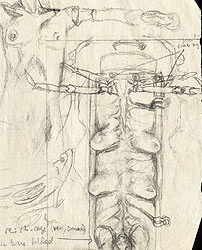
Begin with a really rough drawing, basically getting the idea together but drawn so badly that you require notations to remind yourself what it is you have drawn(!). |
|
 |
|
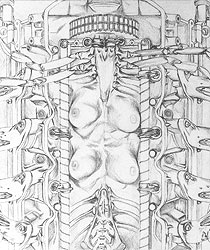 |
Next you work out your canvas size & buy the correct sized stretcher & stretch the canvas over it. Since real canvas isn't made any more, I buy 12 ounce cotton duc. (note: real canvas is "cannabis", mispronounced as canvas, which today is referred to as hemp...!) I then apply 5 to 7 coats of gesso onto the canvas. Then I go about drawing onto the canvas. Because the texture is so coarse I use a hard pencil usually H6 graphite. Then, when I finish drawing, I wash off the pencil "dust" & whilst still wet I paint another thin layer of gesso over it sealing the pencil, which I "pad down" with a cloth so that I can see the pencil lines. |
|
|
|
 |
|
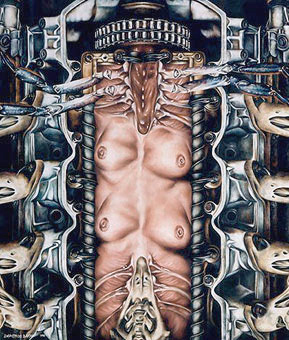
I then begin painting. With this one I began on the "rib-like" aspects on the top & then bottom; then I commenced on the"breast-plate(!)"; then the machinery... commencing from the top right & working around. I am left handed. If I was right handed I would begin from the top left.
One important note: paint brushes. I use watercolour brushes for my oil-painting. Indeed, they are the key to smoothing & merging my tones. Of particular importance is the broad flat brush that I use for merging. These water-colour brushes I use are imitation sable. Despite what they tell you, they are not all the same. Imitation sable is made of nylon. But a difference in the micron thickness of the bristle, its length, etc., dictate how much "spring" the brush has & how coarse it may be.
|
|
|
|
necrophagous. oil on canvas. 1999
|
|
|
|
|
|
|
|
|
|
|
|
|
|
|

|